Recycle je tennisballen
07 december 2025
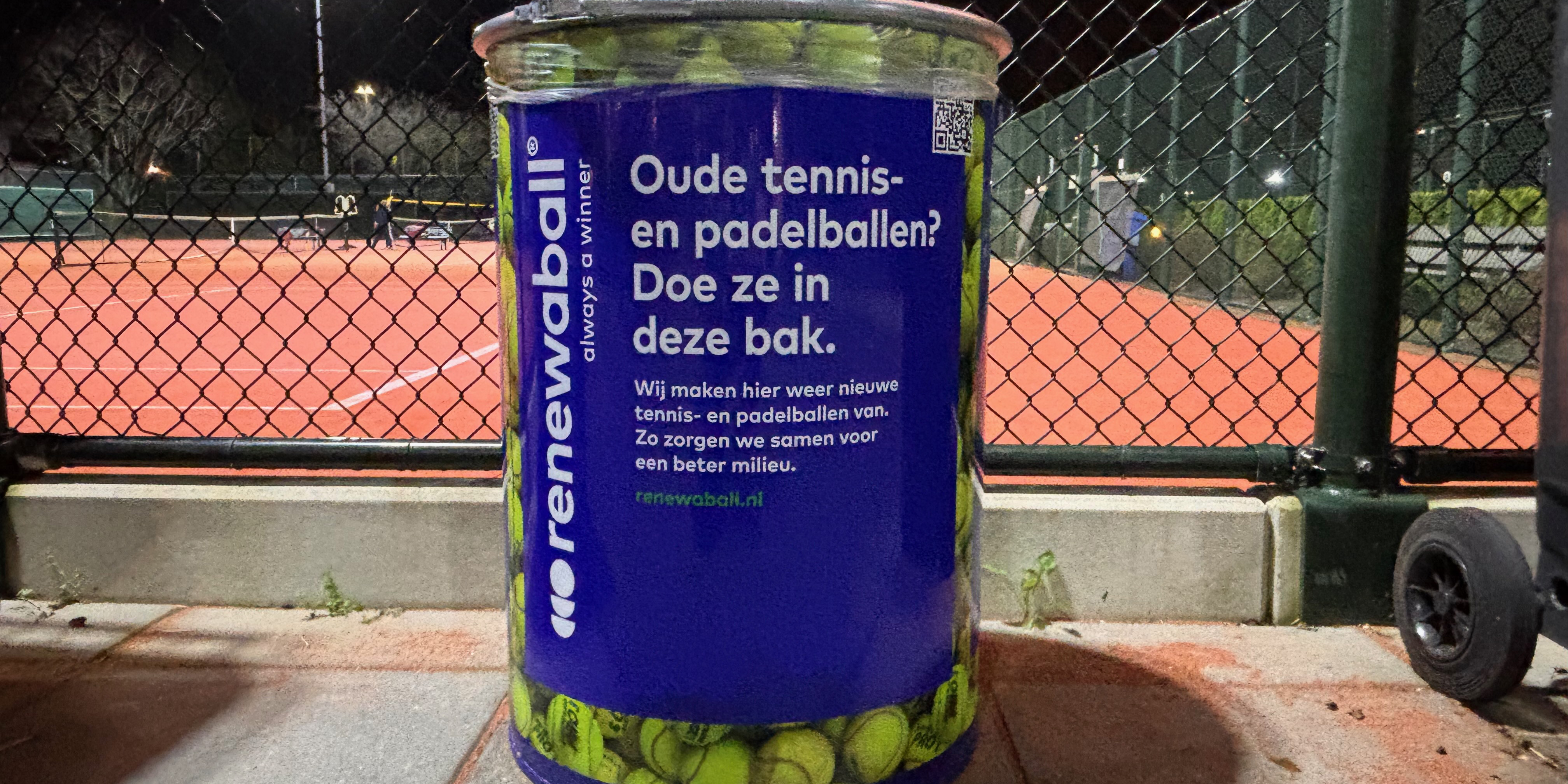
Alle ballen verzamelen!
ATC Kadoelen werkt samen met het enige bedrijf ter wereld dat tennisballen kan recyclen: Renewaball. Een tennisbal bestaat uit twaalf tot twintig componenten (zoals rubber, plastic, lijm, wol, et cetera) die schier onafscheidelijk met elkaar zijn verlijmt. Fijn voor ons spelers, maar haal die twintig onderdelen maar eens uit elkaar op een manier dat je er nog iets aan hebt. Renewaball weet hoe je dat doet en zij maakt er nieuwe tennisballen van.
De grote winst voor het milieu zit ‘m in vliegkilometers. Omdat al die componenten niet op één continent te vinden zijn, legt een tennisbal omgerekend zo’n tachtigduizend (!) kilometer af voordat ‘ie in jouw tennistas zit. Die bal is één van de vijf miljoen (!) tennisballen die jaarlijks in Nederland worden verkocht – en weggegooid.
Er is kleine winst. In de vuilverbranding draagt een tennisbal vooral bij aan CO2 en giftige gassen, wat een goede reden is om die bal na gebruik niet bij het afval te gooien. Ploft een bal na een mislukte backhand in de struiken en blijft ‘ie daar liggen, dan valt hij in het daaropvolgende jaar uit elkaar. De nylon bekleding lost op tot microplastics die door regen en wind in de omgeving worden verspreid. De lijm (formaldehyde) die het boeltje bij elkaar houdt, komt vrij en vergiftigt de bodem. Bacteriën en schimmels sterven, wormen eten de vergiftigde grond, plantjes ontkiemen niet of sterven af. Vogels eten giftige wormen of dode plantjes. Geen cyclus om blij van te worden.
Renewaball biedt voor een hoop problemen die we ons soms niet of nauwelijks bewust zijn, een oplossing. Laten we die gebruiken. Stop je oude tennisballen in de container van Renewaball. Heb je gelijk het gevoel dat je iets goed doet, en dat doe je ook!
Meer info op www.renewaball.com
Let’s have a ball!
ATC Kadoelen collaborates with the only company in the world that can recycle tennis balls: Renewaball. A tennis ball consists of twelve to twenty components (such as rubber, plastic, glue, wool, etc.) that are almost inseparably glueed together. Great for us players, but try taking those twenty components apart in a way they still has some use. Renewaball knows how to do that and makes new tennis balls from them.
The big environmental benefit lies in the air miles. Because all those components aren't found on the same continent, a tennis ball travels the equivalent of about eighty thousand (!) kilometers before it ends up in your tennis bag. That ball is one of the five million (!) tennis balls sold – and discarded – in the Netherlands each year.
And there are small benefits. In the incineration plant, a tennis ball mainly contributes to CO2 and toxic gases, which is a good reason not to throw that ball in the trash after use. If a ball lands in the bushes after a failed backhand and remains there, it will decompose over the next year. The nylon coating dissolves into microplastics that are spread throughout the environment by rain and wind. The glue (formaldehyde) that holds it all together is released and poisons the soil. Bacteria and fungi die, worms feed on the contaminated soil, plants fail to germinate or die. Birds eat poisonous worms or dead plants. Not a cycle to be happy about.
Renewaball offers a solution to many problems we are sometimes unaware of. Let's use it. Put your old tennis balls in the Renewaball container. You'll immediately feel like you're doing something good, and yes you are!
More information at www.renewaball.com
Nieuwscategorieën